
REVIEW · SORRENTO
Private Pompeii Tour with Archaeologist & Winery on Mt Vesuvius
Pompeii is far more than a field of broken columns. With archaeologist Fabrizio Belleni, you can connect the Forum, baths, theatres, homes, bakeries, and shops to the daily lives of the people who once used them. I like the private format and the freedom to adjust the walking route to your interests and energy.
I also like the easy Mercedes minivan transfers and the calm finish at Cantina del Vesuvio, where lunch comes with five wines and views toward the Bay of Naples. The main drawback is cost: the $434.46 price per person is substantial, and the winery meal adds another €50 for the classic tasting or €60 for the superior option.
Key points to know before booking
- Fabrizio Belleni guides the Pompeii visit: His archaeology background helps explain how rooms and ruins fit into Roman daily life.
- The route can change to suit you: The walk may focus on major sights near the Forum, or include special requests when time and energy allow.
- The winery meal is not included in the headline price: Expect to pay €50 or €60 per person on site.
- You see Pompeii’s major public and private buildings: The route may include the Forum, Basilica, baths, theatres, bakeries, taverns, and grand houses.
- Mount Vesuvius is part of the setting, not the climb: The winery sits within the national park, but this tour does not go to the volcano’s summit.
- This is best for a small private party: You get pickup and drop-off, a private van, and a guide focused only on your group.
Why the private Pompeii format works
Pompeii covers roughly 150 acres and once housed about 18,000 people. That is too much ground for a short visit, especially under the hot southern Italian sun. A private tour solves the problem by choosing a useful route instead of pretending you can absorb the whole city in one go.
Fabrizio plans around your interests and physical condition. You can ask for more houses, public buildings, theatres, or everyday-life details. If you have limited time, he can concentrate on the Forum area and the best-preserved highlights. If your group wants a slower pace, the route can be adjusted rather than driven by a rigid schedule.
That personal approach matters at Pompeii. Without context, a broad stone plaza can look like just another ruin. With an archaeologist explaining who used the building, how it worked, and what clues remain, the site becomes much easier to read.
The tour usually lasts four to seven hours, depending on the pace and the time spent at the winery. That is a useful range, but it also means you should confirm the expected schedule when booking. The Pompeii portion requires a moderate level of fitness, with uneven ancient streets and plenty of walking.
More Etna and Volcanic Wine Tours in Italy:
- Private 6-Hour Tour of Three Etna Wineries with food&wine tasting
★ 5.0 · 417 reviews - Private tour of Etna and Winery Visit with Food and Wine Tasting from Taormina
★ 5.0 · 221 reviews - Mount Vesuvius: Vineyard Tour with Wine Tasting and Lunch
★ 4.8 · 193 reviews
Entering through Porta Marina
The route can begin at Piazza Porta Marina, one of Pompeii’s principal entrances. The gate had two arches, one for people and another for carts, and formed part of the city walls. From here, Via Marina leads toward the Forum and several important early stops.
This is a good place to start because it gives you a sense of Pompeii as a functioning city. You are not simply entering a museum compound. You are passing through an ancient access point that connected the city with the sea and its wider trade network.
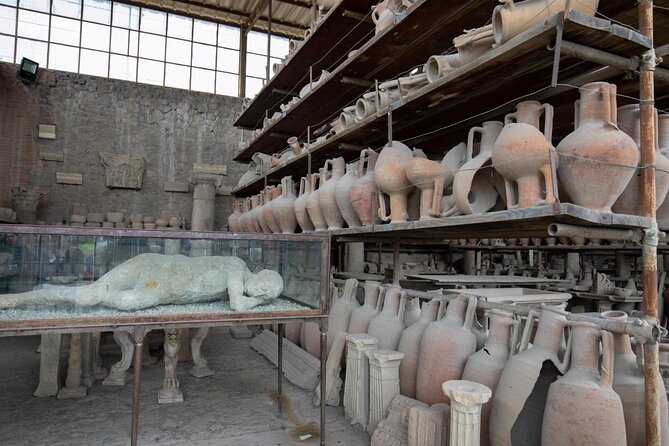
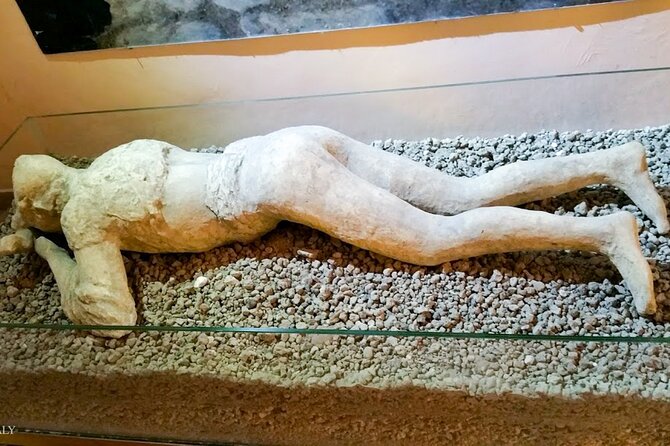
The nearby Antiquarium can also help set the scene. Its displays trace Pompeii from its Samnite roots through Roman rule and the eruption of 79 AD. You can see objects such as the Moregine silver treasure, amulets, frescoes, and plaster casts of victims and animals.
The casts are especially sobering. They put human faces and bodies into a story that can otherwise feel remote. If you prefer to begin outdoors, you can see the museum later in the route.
The Forum, Basilica, and Temple of Apollo

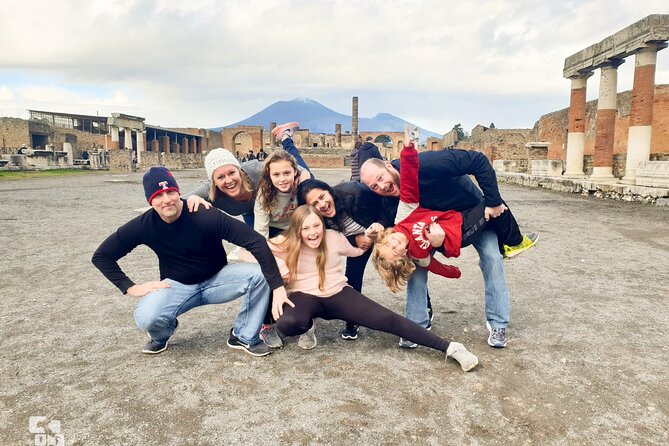
The Forum was Pompeii’s public center. Political business, religious ceremonies, markets, and legal matters all came together here. The rectangular plaza is framed by the remains of important buildings, with Mount Vesuvius visible beyond the city.
You can still see the travertine paving and the bases where statues once honored emperors and local leaders. The Forum is one of the places where a guide earns his fee, since the empty space needs explanation to make sense.
At the southwest corner, the Basilica reveals the business side of Roman life. It was not a church. It served as a courthouse and a place for commercial dealings, with a raised tribunal where magistrates handled legal cases.
The Temple of Apollo offers a different view of the city. It is among Pompeii’s oldest sacred sites, with Greek and Italic design elements. Its portico once had 48 columns, and the courtyard includes a white marble altar and an Ionic column topped with a sundial.
The bronze Apollo and Diana figures now on site are replicas, while the originals are kept in Naples. That distinction is worth knowing, but it does not erase the power of the setting, especially with Vesuvius behind the temple.
Markets, baths, and ordinary Roman routines
The Macellum was Pompeii’s main food market. Shops around the courtyard sold meat, produce, and other goods, while traces in the drainage system point to seafood preparation. A stone table called the mensa ponderaria helped check official weights and measures.
This is one of my favorite kinds of stop because it brings the city down from emperors and temples to lunch shopping. You can also see frescoes and a shrine tied to the imperial family, a reminder that commerce and state religion often shared the same space.
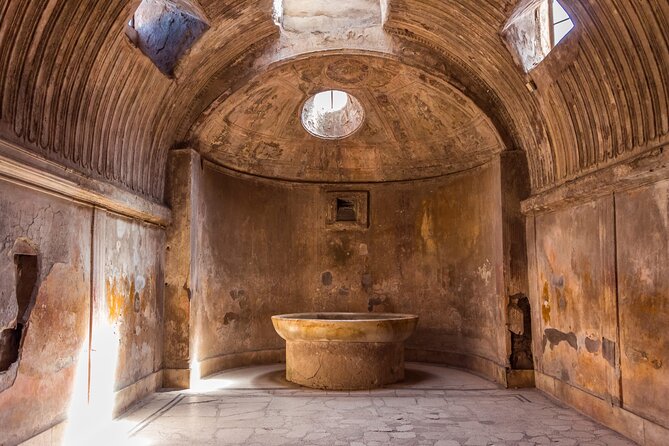
The Forum Baths offer another look at ordinary routines. The surviving rooms include the changing area, cold bath, warm room, and hot room. You can see stucco ceiling work, the bronze brazier, and the hollow walls and floors used to circulate hot air.
The women’s section has also reopened after restoration. The baths were not just places to wash. They were social spaces where people exercised, talked, and spent time together.
Expect the bath complex to be more intimate than the Forum. It is also a place where good explanations matter, since the heating system can be difficult to understand from the remains alone.
More Private Wine Tours in Italy:
- From Florence: Private Chianti Hills Tour with Tasting
★ 4.3 · 809 reviews - Private Self-Guided E-Bike Ride in Tuscany with Vineyard Visit
★ 5.0 · 775 reviews - Pompeii Vineyard Escape: Private Wine Tasting & Lunch
★ 5.0 · 329 reviews - Private Tuscany Tour from Florence Including Siena, San Gimignano and Chianti Wine Region
★ 4.5 · 128 reviews
The House of the Faun and House of the Vettii
Pompeii’s large private homes show how sharply wealth could differ from ordinary urban life. The House of the Faun occupies an entire city block and includes two atriums and two garden courtyards.
Its famous Dancing Faun statue and Alexander Mosaic are now represented by replicas at the site, with the originals in the Naples Archaeological Museum. Even so, the scale of the home gives you a clear idea of how elite families used architecture to display status.
The House of the Vettii is another major highlight. Two former slaves became wealthy merchants and filled their home with elaborate decoration. The restored rooms contain detailed Fourth Style frescoes, mythological scenes, and the famous image of Priapus near the entrance.
The Room of the Cupids is particularly interesting because its small scenes show Roman trades and production. The replanted garden helps you understand how the home was organized around an outdoor courtyard, not simply a set of enclosed rooms.
The Casa dei Vettii is a strong reason to choose a private guide. There is much to see, but the details are easy to miss if you move quickly from room to room.
The Chaste Lovers block and Pompeii’s active archaeology
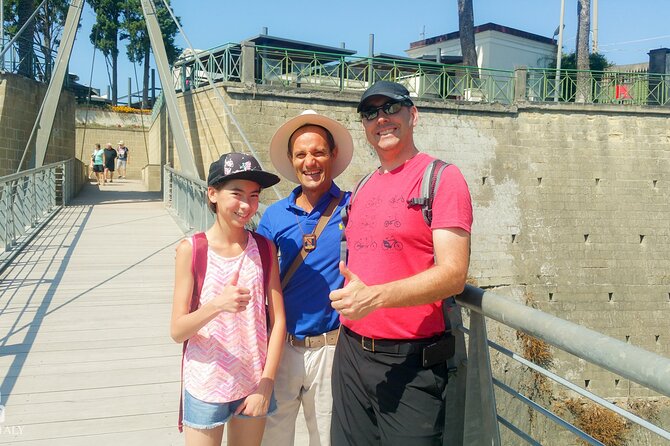
The Insula dei Casti Amanti, or Block of the Chaste Lovers, offers a more current view of Pompeii. It contains homes, a bakery, and the House of the Painters at Work. A raised walkway lets you look down over the buildings and active excavation areas.
This stop shows that Pompeii is not a finished collection of ruins. Archaeologists are still studying houses, work areas, walls, and objects. The route is also part of the Pompeii for All access program, which makes this section easier to view for people who need a more accessible path.
Do not expect every area of Pompeii to be equally easy underfoot. The site is large and historic paving can be uneven. The private format helps because Fabrizio can respond to your group’s pace, but you should still wear practical shoes and bring water.
Theatre life in the Teatro Grande
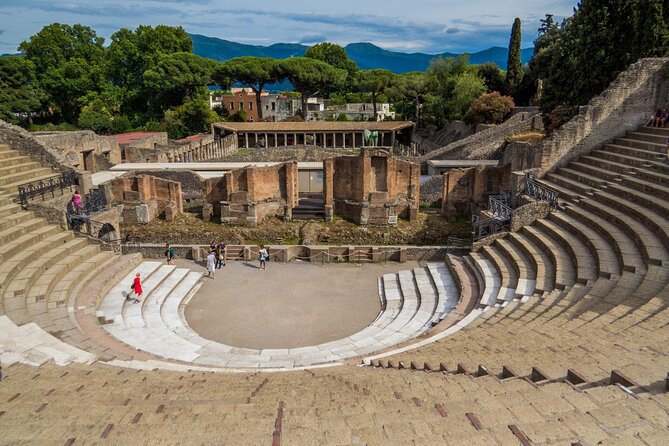
The Teatro Grande is a horseshoe-shaped theatre built into a natural slope. It could hold around 5,000 people, with seating arranged according to social rank. Marble-lined lower seats were reserved for local elites, while higher areas served the general public.
The acoustics are still strong enough for you to test with your own voice from the orchestra. The theatre also continues to host cultural events, including the Pompeii Theatrum Mundi summer season and occasional choral performances.
Near it, the smaller theatre offers a more compact setting. Together, the two theatres show that Pompeii was not only a place of trade, worship, and politics. It was also a city where people gathered for entertainment.
If theatre architecture interests you, tell Fabrizio in advance. The published route is flexible, and a private guide can spend more time here instead of rushing to cover every possible street.
Cantina del Vesuvio: five wines and a generous lunch
After Pompeii, the Mercedes van takes you to Cantina del Vesuvio, about 10 to 15 minutes away according to the tour details. The winery is a family operation connected with the Russo family since 1930 and sits within Mount Vesuvius National Park.
The winery visit begins with a guided 15-minute walk through the vineyards. You learn about the local Lacryma Christi wines while looking across the Bay of Naples and toward the volcanic crater.
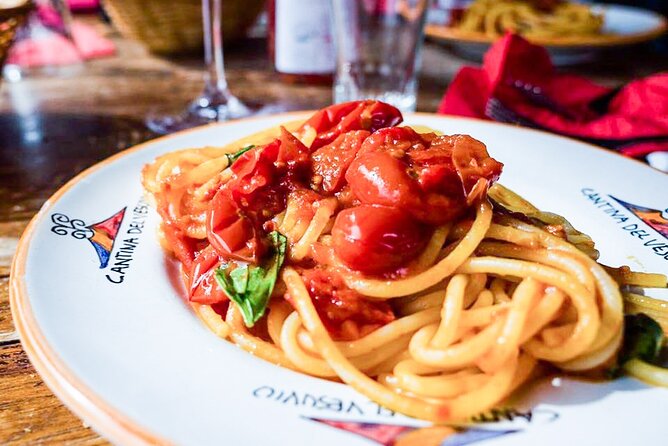
The meal is served as a set menu. It starts with a Neapolitan plate of ricotta, bruschetta with cherry tomatoes, provolone, salame, and capocollo. The main course is spaghetti with Vesuvius cherry tomatoes, using pasta from a local producer. Dessert is pastiera, a traditional Neapolitan cake made with ricotta and wheat.
Five wines accompany the meal. A classic tasting costs €50 per person, while the superior wine option costs €60. The meal and tasting are paid at the winery by card or cash, and Fabrizio handles the reservation.
Vegetarian and gluten-free options are available, but you should mention dietary needs ahead of time. The winery can also arrange shipping if you want to send wine or olive oil home.
This is a pleasant change of pace after the ruins. Pompeii requires focus and walking. The vineyard stop gives you a chair, a meal, and time to enjoy the region’s food and wine without adding another major sight to your day.
Price, transport, and practical value
At $434.46 per person, this is not a budget Pompeii excursion. You are paying for a private guide, private air-conditioned Mercedes minivan transportation, pickup and drop-off, Pompeii Express skip-the-line admission, and a reserved winery experience.
The winery lunch is extra, which changes the real cost. Add €50 or €60 per person for the tasting and meal. Before paying, confirm exactly which Pompeii admission option is included, since the tour details describe entry as included while also presenting ticket inclusion as an option.
The price makes the most sense for couples, families, or small groups who value control over the day. Group discounts are available, and the private setup can be good value when the cost is shared among several people.
Pickup is offered in Sorrento and Naples, with the exact meeting place arranged directly. You provide the meeting location and a phone number for the day. Children must be accompanied by an adult, and service animals are allowed.
The tour is offered in English. Confirmation is normally immediate unless you book within one day of departure, when it depends on availability. Free cancellation is available up to 24 hours before the start time.
Who should book this Pompeii and winery day?
I would choose this experience if you want Pompeii explained by an archaeology specialist rather than explored alone. It suits anyone who wants to ask questions, adjust the route, or focus on Roman homes, public life, engineering, or art.
It is also a good match if you are staying in Sorrento and want transportation handled from start to finish. The cooler with water in the van is a small but useful touch, especially after walking across the exposed ruins.
You should think twice if your main goal is to climb Mount Vesuvius. This tour includes the winery and views of the volcano, but it does not reach the summit.
You should also allow enough time for the walking. The private guide can adapt the pace, but Pompeii itself remains large. Comfortable shoes, sun protection, and water are sensible choices.
Should you book it?
Book this tour if you want a flexible Pompeii visit, a dedicated archaeologist, and a relaxed food-and-wine finish. Fabrizio’s ability to tailor the route is the central advantage, particularly for a group with mixed interests or different walking speeds.
Skip it if you want a low-cost group excursion, a full climb of Vesuvius, or complete control over your own schedule. For everyone else, the combination of Pompeii’s major sights, private transport, and a family winery meal offers a well-balanced day, provided you budget for the extra €50 or €60 tasting.
FAQ
Where does the tour begin?
Pickup is offered from Sorrento and Naples. You arrange the exact meeting place and provide your phone number for the tour day.
Who guides the Pompeii visit?
The private walking tour is led by Fabrizio Belleni, an official guide with archaeology expertise.
How long does the experience last?
The tour lasts approximately four to seven hours, depending on the walking route, pace, and winery visit.
Is Pompeii admission included?
The included services list Pompeii Express skip-the-line admission. Because the tour details also describe ticket inclusion as an option, confirm the exact booking choice before payment.
What does the Pompeii route include?
The route may include Porta Marina, the Forum, Basilica, Temple of Apollo, Macellum, Forum Baths, House of the Faun, House of the Vettii, Chaste Lovers block, theatres, and the Antiquarium.
Can the Pompeii itinerary be customized?
Yes. The route is adjusted to your interests and physical condition. Special requests should be sent ahead of time.
Is the winery lunch included in the tour price?
No. The winery visit is reserved, but you pay separately on site. The classic tasting with lunch costs €50 per person, and the superior option costs €60.
What food is served at the winery?
The set menu includes a Neapolitan starter, spaghetti with Vesuvius cherry tomatoes, and pastiera for dessert. Vegetarian and gluten-free options are available.
Does the tour climb Mount Vesuvius?
No. The tour visits a winery within Mount Vesuvius National Park, but it does not go to the volcano’s summit.
What cancellation terms apply?
You can cancel for a full refund up to 24 hours before the experience starts. Cancellations or changes made less than 24 hours before departure are not accepted for a refund.
Just added around Italy
- Primitivo and Negroamaro wine tour: a visit to two wineries and typical lunch. From Lecce★ 5.0 · 19 reviews
- Visit to a Winery in Salento with Wine tasting and light lunch. From Lecce★ 4.5 · 10 reviews
- Discover the best cellars of Salento★ 5.0 · 30 reviews
- Full Day Tour to Gallipoli, Galatina, Coast, Beaches and Winery★ 5.0 · 39 reviews
- “Between Langhe and Monferrato” – Wine Tasting and Cellar Visit★ 5.0 · 86 reviews
- Visit among vineyards and wine cellar with wine tasting in Nizza Monferrato★ 5.0 · 10 reviews
- Barolo Tasting and Vineyard Tour and Winery Visit★ 4.5 · 2 reviews
- Guided Walk and Lunch in the Vineyard in Alba★ 4.5 · 2 reviews
Sorrento Vineyard Tours, compared.
Pompeii, Herculaneum and Winery on Vesuvius with an Archaeologist
Read our review →
Cortecorbo Irpinia-wines: tour of the vineyards- Cooking class- wine tasting
Read our review →
Sorrento Coast E-Bike Tour and Visit at Vinegar Cellar
Read our review →
Campania Express Train Pompeii Tour with Vesuvius or Winery
Read our review →
Browse the lists this tour appears in